


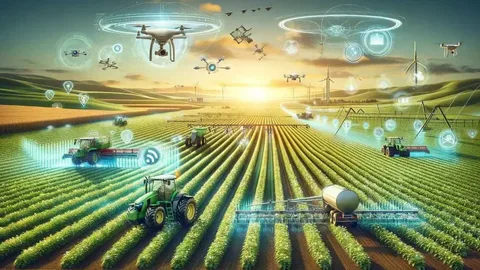
In an era where environmental concerns and food security are top priorities, the need for efficient and sustainable farming practices has never been greater. Precision agriculture, often referred to as smart farming, is emerging as one of the most powerful tools in the agricultural sector to address these challenges. By integrating advanced technology with traditional farming practices, precision agriculture promises to enhance productivity while minimizing environmental impact. In this article, we explore how precision agriculture is transforming modern farming and driving sustainability.
What is Precision Agriculture?
Precision agriculture involves the use of advanced technologies such as GPS, sensors, data analytics, and Internet of Things (IoT) devices to monitor and manage farming operations more precisely. Unlike conventional farming methods, which often rely on broad-based approaches, precision agriculture allows farmers to make data-driven decisions that are tailored to the specific needs of their crops, fields, and environments.
The technology enables farmers to optimize the use of resources like water, fertilizers, pesticides, and seeds. By ensuring that inputs are applied only where and when they are needed, precision agriculture can significantly reduce waste and improve overall efficiency.
The Benefits of Precision Agriculture for Sustainable Farming
1. Efficient Resource Management
One of the most significant benefits of precision agriculture is its ability to optimize resource use. With the help of sensors and satellite imagery, farmers can monitor soil moisture levels, crop health, and weather patterns in real-time. This allows for more precise irrigation, fertilization, and pesticide application, reducing water and chemical waste. In turn, this lowers the environmental impact of farming, preserving valuable resources and reducing the need for synthetic inputs.
2. Reduced Environmental Footprint
By applying fertilizers and pesticides in a more targeted manner, precision agriculture minimizes runoff, which can contaminate local water supplies and harm surrounding ecosystems. Precision farming technologies can also help reduce soil erosion and over-planting, leading to healthier soil and better long-term land productivity. This contributes to more sustainable farming practices and helps protect biodiversity.
3. Increased Crop Yields
Precision agriculture helps farmers monitor crop growth on a granular level, allowing them to address problems early, such as pest infestations, diseases, or nutrient deficiencies. By being proactive, farmers can avoid yield losses and improve crop quality. Moreover, by managing crops more efficiently, farmers can boost yields without needing to expand their land, which is a critical factor in ensuring food security in the face of a growing global population.
4. Cost Savings
Precision agriculture reduces the need for over-applying inputs such as water, fertilizers, and pesticides. This not only cuts down on operational costs but also increases overall farm profitability. By making informed decisions about where to allocate resources, farmers can run more cost-effective operations while achieving higher productivity.
Technologies Driving Precision Agriculture
1. GPS and Remote Sensing
Global Positioning System (GPS) technology is a key component of precision agriculture. It enables farmers to map their fields with incredible accuracy and monitor them for issues like soil health, crop stress, and irrigation needs. Coupled with remote sensing technologies such as drones and satellites, GPS allows for the collection of high-resolution data that can inform decisions about planting, fertilization, and harvesting.
2. IoT Sensors
Internet of Things (IoT) sensors are used to gather real-time data from the field. These sensors can track soil moisture, temperature, humidity, and even crop growth stages. By integrating this data into farm management systems, farmers can make more timely and accurate decisions, ensuring that crops receive the precise amount of care they need.
3. Data Analytics and AI
The vast amount of data generated through precision agriculture requires sophisticated analytics tools to make sense of it all. Artificial Intelligence (AI) and machine learning algorithms are increasingly being used to analyze this data, offering insights into patterns and trends that humans might miss. These insights can help farmers predict future conditions, optimize planting schedules, and reduce crop loss.
Challenges and the Future of Precision Agriculture
While precision agriculture offers enormous potential for sustainable farming, it also comes with some challenges. The initial investment in technology can be high, and the adoption of these systems requires significant training and a shift in mindset for many farmers. Additionally, access to high-speed internet and reliable data infrastructure can be a barrier, particularly in rural areas.
However, as technology becomes more affordable and accessible, the benefits of precision agriculture will likely continue to grow. Collaboration between tech companies, governments, and farmers will be essential to overcoming these challenges and ensuring that sustainable farming practices become the norm rather than the exception.
Conclusion
Precision agriculture is undoubtedly a game-changer in the world of farming. By utilizing cutting-edge technologies, it offers a path toward more sustainable farming practices that can help address global food security challenges while reducing environmental impacts. As the agricultural sector continues to evolve, the widespread adoption of precision agriculture will be crucial in ensuring that we can feed the world in an environmentally responsible way. With its potential to increase efficiency, reduce waste, and improve yields, precision agriculture is truly the key to the future of sustainable farming.
